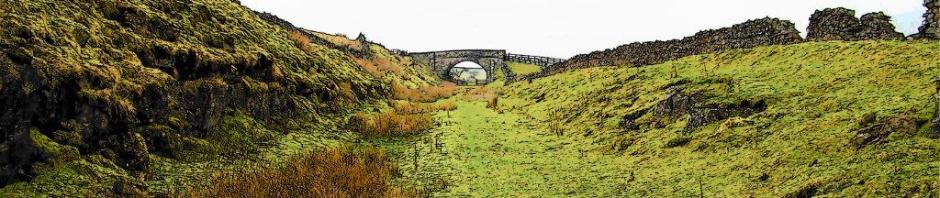
 STAINMORE Summit is a place where arteries of British blood, history, endeavour and fortitude have been pinched together in a tightly-throbbing bundle. It might look like a bleak place with a couple of lorries parked in a lay-by and not much else, but there is drama here. Beyond the tarmac of the A66 and the snow-poles that mark its length, past the furthest Coca-cola bottle and the faded carrier bags snagged on roadside fences, is a vast bogland that cloaks a human journey across several millennia . . .
 The sharp-eyed might note that the summit of this Pennine pass sits squarely in the line of fire of a Second World War pill-box on a bluff to the south, its gun ports battened shut behind hinged iron plates ??? except the one directly facing the highest point of the road, which is open . . . and watching.
The grassy track on the northern side of the dual-carriageway that climbs an escarpment from the Cumbrian side and cuts down into Durham, that???s the Roman road from Verteris, the fort at Brough, to Lavatris, the fort at Bowes. Soldiers from Thrace were stationed at Lavatris. Their blood is in the Stainmore turf along with the blood of Brigantes. That???s why the bog-water???s brown.
Just east of the summit is a place called Spital. A common element in English place names, Spital is a corruption of ???hospital???, and can mean exactly what is says on the label or, alternatively, can derive from a place where ???hospitality??? was proffered during mediaeval times to weary souls traversing a hostile environment. The old coaching inns on either side of the summit continued this tradition into later centuries.
But we???re not concerned with Romans or mediaeval travellers. And we???re not concerned with the Tommies who manned what has been described as ???the country???s most bleakly located pill box??? (a Type F/W24, apparently), although they must have had fascinating stories to tell. What we???re interested in is another major artery that squeezed through this notorious gap ??? an artery made of iron ??? and an incident that occurred during the winter of 1955 that was enshrined on celluloid and gave Stainmore Summit precisely nine minutes and 37 seconds of fame.
 From where I sit on my collapsible stool, sheltering behind the car from the blast of a westerly wind as I pull on my boots, I can see the line of the Stainmore Railway descending from the pass on its zigzagging course to Kirkby Stephen. The trackbed is easily discernable on the Cumbrian side ??? a grassy shelf skirting the moor, a concrete hut with a gaping doorway, tell-tale embankments and the odd cattle arch. On the Durham side, all that can be seen is the distant slit of a railway cutting that melts into bogland and history. The last train ran in 1962. I???ve missed it.
What I haven???t missed is the nine minutes and 37 seconds of British Transport Films documentary that was shot a few hundred yards across the moor. It was filmed in the days when the British worker was regarded ??? rightly ??? as a decent chap who would willingly turn his hand to anything and do a first-rate job; not ??? wrongly ??? a vacuous moron in a fluorescent jacket who is incapable of filling a pothole without completing a risk-assessment form. This 1955 film tells us as much about ourselves today and what we have become as it does about the ruddy-cheeked, cap-wearing, tea-drinking, tab-smoking people we were back then.
Snowdrift at Bleath Gill documents the rescue of a goods train pulled by engine number 78018, which became snowbound just below the summit on February 24, 1955. Abandoned to the elements, the engine cools and freezes to a solid block of ice. Locos with snowploughs are despatched from Darlington to clear the track, but they too are defeated. Five days later, after digging night and day as the winter wind whips spindrift across the fells, a team of workmen from West Auckland and Darlington clear the way sufficiently for a plough to charge through. They then defrost the 78018???s wheels and valves with steam hoses and bundles of blazing cotton waste soaked in paraffin.

 Snowdrift at Bleath Gill is British newsreel cinema at its best and most poignant. Yes, the Soviets could do proud working women clutching hoes in one hand and babies in the other, and chisel-featured miners wielding pneumatic drills like rifles as they march beneath scarlet banners ??? but we had blokes in old macs and flat caps digging snow on what was, in 1955, the highest mainline railway in England with little sustenance other than tobacco and sandwiches sent up from the ???refreshment rooms??? in Barnard Castle. We had the vanguard of the nationalised industries showing the world how to pull together and fight and win. We didn???t need flags and military music; our hearts were stirred by honest workmen doing their bit with a grin and a cheery wave.
So I???m off across the moor with the A66 behind me, marching along the trackbed of the Stainmore Railway in search of Bleath Gill and the place where engine number 78018 sighed its last breath of steam before the February night turned its heart to ice.
If you???ve stuck with me this far you???ve reached a good place to put the kettle on and watch the film, because I???ve two or three sidelines to steam along before I???m through. I???m expecting to have a hearty walk and a bloody good rant, because there???s more to this Bleath Gill incident than meets the eye. So make a brew of strong tea ??? preferably in a pint mug with blue stripes ??? and allow Deryck Guyler to transport you back to 1955 with Snowdrift at Bleath Gill.

Trackbed of the Stainmore Railway, just below the summit on the Cumbrian side with the A66 in the background
THE section of track where the 78018 wheezed to a halt is only a few minutes??? trudge along the spongy trackbed from the A66. I???ve passed the concrete hut with its gaping doorway that can be seen from the dual carriageway, walked under a bridge that carries a minor road to Barras, and am steaming along an open stretch of line beneath Bleathgill Farm where the drama took place. The day is cold and blustery, with an evil wind rasping off the Lakeland fells and scouring the Pennines. But it???s not as cold as it was during those long, dark nights in February 1955 when men shovelled snow by the light of pressure lamps.
 Apparently there???s a chap on Tyneside who runs guided walks around locations that featured in Michael Caine???s epic gangster movie Get Carter. No one performs a similar service for Snowdrift at Bleath Gill, so pinpointing the exact location of where the engine was stuck is not easy. There???s no blue plaque, no memorial. Another disappointment is that where Get Carter has spawned any number of budding Michael Caine impersonators drawling: ???You???re a big man but you???re in bad shape,??? there???s no one up here mimicking Deryck Guyler saying: ???The thing is, to give the ploughs a reasonable chance of getting through a drift without getting stuck
 , we have to cut the snow up into chunks. Like eating landlady???s cake, the more it???s divided, the easier it is to get through.???
I tarry a while in the area where the engine came to a standstill then carry on down the track. My plan is to walk as far as the Stainmore Railway???s second claim to fame, the Belah viaduct ??? the country???s tallest railway bridge ??? bearing in mind much of the trackbed is now in private ownership and partitioned off behind unfriendly walls and unfriendlier barbed wire. What once belonged to the public is now in the hands of farmers. Not that stuff like that should deter a determined walker. As Deryck Guyler says: ???When this sort of thing happens we get stuck into it ??? and then dig ourselves out.???

The section of track where the 78018 came to a halt in the snow

Click map to enlarge
So I walk on down the line, leaving the 78018 to be towed in the other direction over Stainmore Summit and into history. Incidentally, the 78018 was built in Darlington in 1954. It was virtually brand new when it got stuck in the drift. It survived the Stainmore Railway by several years, being despatched to the scapyard in November 1966. The line was closed in 1962, not by Dr Richard Beeching, the Tories??? infamous railway hatchet man, but by the Minister of Transport ??? road and motorway builder Ernest Marples.
Hold your stripy mug a minute while I apply the brakes. Pardon me if the wheels screech a bit on the wet rails, but did you note that rather pertinent point or did it flash past like a telegraph pole at the side of the track? The Conservative government???s Transport Secretary, the man responsible for closing the Stainmore Railway and appointing Dr Beeching to axe many more, was a road and motorway builder. Do you detect a rather significant conflict of interest here? A man who runs a company that builds roads, whose fortune has been amassed by the application of tarmac across the length and breadth of Britain, was the man who initiated the programme to tear up Britain???s railways, close stations and deprive rural communities of their transport links.
Yes, there was a conflict of interest, so much so that Marples was asked to dispose of his shares in his own company ??? Marples-Ridgway. So he sold them . . . to his wife. Wikipedia has this to say on the subject:
It is quite astonishing, with even a little thought applied to the matter, that the person responsible for closing the railways was also getting the contracts to build the roads that would have to replace them. It was Ernest Marples who closed one third of Britain’s railways, not Beeching, who was merely the civil servant who wrote a report on the subject.
To cut a long and extremely colourful story short, Marples was elevated to the Lords but fled the country in 1975 to Monaco, avoiding an array of tax bills and legal problems. There were also claims he was involved with prostitutes and had been tangled up in the Profumo affair. The Treasury froze his assets. Peculiarly, no chaps from West Auckland and Darlington rushed forward to thaw them out with steam hoses and cotton waste.
 Marples was a crook in high office who closed the railways for private gain while parroting the excuse that the country could no longer afford to run them. There are no crooks in high office pulling similar stunts nowadays, of course, because we live in an age of transparency and accountability. But I???ll bet you my last ??5 there are any number of puffy-palmed businessmen and slimy-tongued lobbyists creeping through the corridors of power ??? sharp suits representing private health providers, care providers and service providers ??? whispering in the ears of influential people: ???Cut this. Cut that. Cut the other. Tell them there???s no money left. They always fall for that one.??? Thirty years down the line, when the records have been made public and the history books on the Age of Austerity written, just see if I???m wrong.
WHOOPS. A farmer???s wife is watching me clambering over a fence. She???s standing in the road near Barras station (formerly England???s highest mainline station, a title that has been shunted across the hills to Dent), which is now a private house. She has a look of grave concern carved into her face and her collie is straining on its lead. To make things worse, I discover I have clambered into a section of trackbed that is hemmed in on all sides by barbed wire and walls ??? so I am obliged to climb out again. This I accomplish as nonchalantly as possible, like a man who has made a mistake that anyone can make. I even whistle as I am doing it.
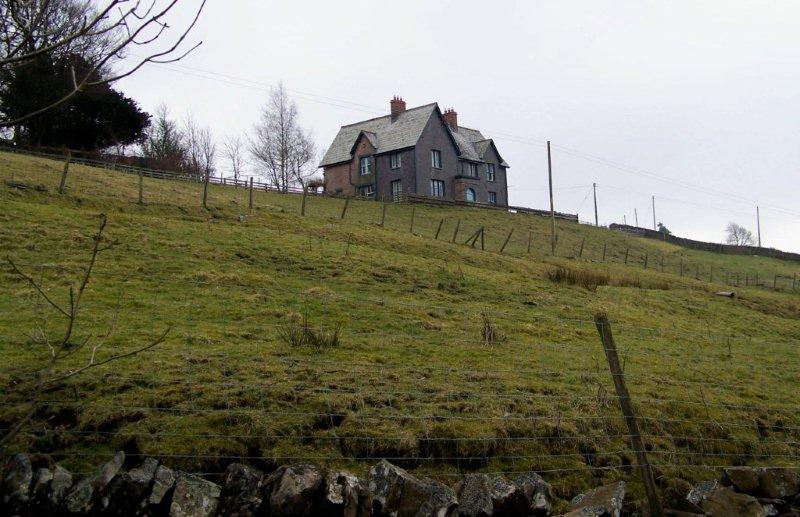
Barras Station
She asks me if she can be of assistance. I tell her it???s my intention to reach the site of the Belah viaduct by the route of the old railway line, but progress is being hampered by obstacles that weren???t in evidence when the last train steamed through. So we discuss other options. Then we discuss the weather and the curtains she has just finished washing in her farmhouse kitchen. Then we discuss the Cumbrian quarrying industry, Italian stone saws and the price of roofing slate. Then we discover we have a mutual friend who lives near Appleby. And so a pleasant fifteen minutes elapse before we part with a wave and a smile, and I follow her suggested route along quiet lanes to New Hall Farm, and a footpath that cuts down to the river Belah and the imposing buttresses of the Belah viaduct.
 No one, so far as I am aware, has ever written a poem about the Belah viaduct. It no longer exists, by the way. It was demolished in 1963 by a company from County Durham called Golightly. They took away the 196ft-high Meccano-like structure as scrap, leaving only stone bastions that stand like Tolkienian watchtowers on either side of the ravine. Someone did, however, write a couple of poems about the River Tay railway bridge, which was designed by the same engineer. That poet was William McGonagall, and his poems possess all the rhythm and metre of a steam engine with three square wheels:
Beautiful Railway Bridge of the Silv’ry Tay!
Alas! I am very sorry to say
That ninety lives have been taken away
On the last Sabbath day of 1879,
Which will be remember’d for a very long time.
McGonagall has been described as the world???s best bad poet. His poem, The Tay Bridge Disaster, was penned in the wake of the most notorious episode in British railway history, and followed a celebratory composition called The Railway Bridge of the Silvery Tay, which has the following verse in praise of the designers:
Beautiful Railway Bridge of the Silvery Tay!
And prosperity to Messrs Bouche and Grothe,
The famous engineers of the present day,
Who have succeeded in erecting the Railway
Bridge of the Silvery Tay,
Which stands unequalled to be seen
Near by Dundee and the Magdalen Green.
Belah viaduct was designed by Thomas Bouche, a chap from Thursby in Cumbria. Unlike his unfortunate Beautiful Railway Bridge of the Silvery Tay, his Beautiful Railway Bridge of the Bog-coloured Belah stood the test of time and didn???t tumble down and kill lots of people. We native Cumbrians should be thankful.

The remains of the Belah viaduct. Looking towards the south buttress from the north buttress

The south buttress of the Belah viaduct from the path near New Hall Farm
So I scramble up a breathless 196ft from the fast-flowing Belah to the most southerly watchtower and discover a veritable wonderland of railway history. Not only does the southern buttress rise magnificently in the peace and solitude of this Pennine backwater, but a few yards down the track stand the ruins of the Belah signal box. Oh, what joy. Most boys ??? in my generation at least ??? dreamed of being engine drivers. I extended that dream into my teenage years when I retired from the footplate and took up residence in a signal box, complete with its ringing bells, ticking clock, coloured levers and ??? most importantly ??? fireplace chock-full of hissing coal. What better place to play with trains and dream of climbing mountains? Throw in a level crossing and a big wheel to open the gates and the dream???s complete.

 My walk ??? this walk, our walk ??? hits a set of points here and diverges. In reality I continue down the track to Howgill Foot Farm, passing the ruins of a wooden trestle bridge that spanned the line. But there are more obstacles at Howgill Foot, and that???s as far as I get. So for convenience we???ll cut up a pleasant road just west of the viaduct to the delightful Wrengill Farm, recross the Belah on a public footpath to High Ewebank Farm, and drop down by another path to the northerly viaduct buttress ??? where I have a cuppa and a quick kip in soft grass.
 From the northern buttress a number of return options present themselves. I opt to walk north along the trackbed through a boggy cutting, where I chance upon a lump of coal that has lain there for at least fifty years, then, finding my way barred again at the old Belah station, cut up the fell through abandoned quarries and return to Bleath Gill along empty minor roads. And at Bleath Gill, where the old stone bridge crosses the railway line, I stand with elbows on the parapet surveying the place where the 78018 froze to the rails and an army of shovel-wielding, swearing, smoking, laughing, salt-of-the-earth-type fathers, sons, uncles and brothers dug it out. And it was all in a day???s work.
 We don???t do heroes in this country any more ??? with the exception of the boys flown back from Afghanistan in boxes, god bless them. Instead, we pour scorn on the people who keep this country moving. When a train service fails in a blizzard, the national press ??? staffed by people who wouldn???t know one end of a shovel from the other ??? trot out ???wrong kind of snow??? headlines with a regularity that is as predictable as it is unprofessional. Road workers are depicted as being so incapable they have allowed our highways to become pitted with potholes and choked with traffic cones. Firefighters are maligned because some supplement their wages with second jobs. Town hall officials are jobsworths with gold-plated pensions. Teachers are whingers. Plumbers are all Polish. Builders are all cowboys. And in a barrage so ruthless it has changed perceptions almost overnight, public sector office workers ??? wages, pensions, health, social security, social services, local authority personnel and police ancillary workers ??? have become ???back office staff???,?? which somehow renders them dispensable. That???s what we do in this country. You want to save money? You want cuts? You want to push through a programme of austerity? Then denigrate the people you???ve targeted and cut them down like brambles in a railway siding. If they complain, just tell them they don???t understand the economic realities and they???re being led by union dinosaurs. Because the people at the top always know best. Like Ernest Marples.
 But the heroes are still out there. Looking north from the railway bridge, the A66 slants down from Stainmore Summit absolutely chock-a-block with lorries. During the past two winters it has been closed several times for days on end as blizzards raged. During those blizzards, and in the darkness of night while the rest of us were in our beds, blokes in snowploughs were fighting a losing battle to keep the traffic flowing. They were up there at an elevation of 1,300ft in two of the worst winters on record, doing their bit without thanks or praise. Those men are heroes, just like the flat-capped railwaymen who dug out the 78018 in the teeth of a 40mph wind. Just like the nurses, the trawlermen, the roadworkers, the steelworkers, the dinner ladies, the refuse collectors and the countless hundreds of thousands of others who keep this country moving. We just don???t make films about them any more.
DON???T go yet because there???s a happy ending to this story. In fact, it???s the happiest of happy endings. The ending is so happy that if Walt Disney made a sequel to Snowdrift at Bleath Gill, no one would believe it. They???d think the director made it up.
Let???s go back a few years to when England won the World Cup. In November 1966 the 78018 was decommissioned and ended up in the most famous of ??locomotives??? graveyards ??? Woodham Brothers scrapyard in Barry, south Wales. There it rotted for more than 11 years before being hauled away by a group of steam enthusiasts who took it to Shakerstone, Leicestershire. But very little work was carried out, and again it sat rotting in a siding.
Then in 1981 a group of railway enthusiasts from a North-East town bought the 78018 with a view to getting it back into working order. Thirty years later, that work is nearly complete. That group is the Darlington Railway Preservation Society. And someday soon the 78018 will steam out of the shed it has occupied for three decades ??? only a few hundred yards from where it was built.*
Told you. Endings don???t come much happier than that.
* Much has happened since this article was posted, and I am glad to report that the 78018 has been fully restored (although not in Darlington) and re-entered service in Loughborough in September 2016.

MUST SEE
- Take a look at the 78018 on the Darlington Railway Preservation Society website
FURTHER READING
- Chris Lloyd in The Northern Echo, November 11, 2009, ??interviews Jackie Leng, one of the workmen who dug out the 78018
- Mike Amos in The Northern Echo, May 27, 2009, recalls the last train over Stainmore Summit
- Mike Amos in The Northern Echo, January 27, 2011, a 78018 update
- History of the Eden Valley and Stainmore Railway







After reading your post and watching the clip I think that not only should you be made Prime Minister you should be made Supreme Dictator !
many thanks from Danny
LikeLike
Thanks Danny. I’ll settle for Supreme Dictator.
LikeLike
Brilliant stuff again. I lived in Tebay in the 60s and we had snow up to the bed room windows. My dad worked for the coop in Tebay (now shut) and drove the travelling shop which delivered to all the farms in the area. One snowy winter my dad was concerned because the lanes from the top of Grayrigg Hause down to Lowgill were blocked wall to wall with snow. We drove up there in the van and towed loaves of bread on sledges down to Lowgill shop. The thanks he got was redundancy when Kirkby Stephen coop took over a few years later.
LikeLike
And they call them the good old days. I’ve ducked the redundancy axe twice in the past two years Greg ??? but the next time it swings I think I’ll be following your dad. It’s the same old story, as they say.
LikeLike
Marvellous to read that the Bleath Gill loco will soon be steaming again. I have the film on my recorder from when it was shown on BBC4 in March 2010. They don’t make films like that any more – more’s the pity. Last time we went over the A66 to the Lakes we were looking at the map and working out approximately where the train was snowbound, so next time we’ll have to follow in your footsteps and see for ourselves.
LikeLike
We know the film well, my 7 and 3 year old watch it at least once a week, several times over! The big one has expressed an interest in going to the site itself and now I have a route. Thank you!
LikeLike
Glad to be of assistance, Christine. My two-year-old granddaughter watches back-to-back Thomas the Tank Engine DVDs so perhaps she’ll graduate to Bleath Gill sometime.
Cheers, Alen
LikeLike
Brilliant piece. It certainly brought a smile to my dads face – he was a fireman at West Auckland shed at the time and though he missed that particular event, he tells good tales of other occasions including on the Stainmore line, with a snow plough on the front, getting up a good head of steam to pile into a snow block, absolutely blind to what may be hidden beneath it. A world away from today!
Cheers, David
LikeLike
Hi David. Thanks very much for that. It’s rewarding to know that people have enjoyed reading it ??? and particularly people who had connections with that event and work like it. The conditions on Stainmore and other high places must have been absolutely horrendous to work in. Hats off to your dad!
All the best, Alen
LikeLike
Hi! im a huge SDLU fan .having visited most of the station sites.i was only up at Bleath Gill last wed 19th June at sunset, felt some guilt disturbing the Curlews and Lapwings tho. we have a caravan near Appleby so im always dragging the wife and dogs on railway walks , Big hill cutting , Rookby Scarth and Smardale was very interesting. Very much enjoyed your article . . . .Ronnie
LikeLike
Hi Ronnie. I drove through Appleby the day after you were on your walk. It’s great up there. I’ve never ventured through Smardale so that’s somewhere on my list of things to do. I’ve heard there’s an impressive viaduct there. Appleby’s a great place. I have friends there and visit it quite a lot.
Cheers, Alen
LikeLike
Hi Alen,
A brilliantly written piece and one I came across after doing a Google on Snowdrift at Bleath Gill. Excellent film and photographed by Bob Paynter and David Watkin (Bob went on to be a DOP on 70’s TV shows like Minder from the likes of Euston Films. A personal memory of 78018 was that it was stored in 1965 in sidings at Sutton Bridge near Shrewsbury a few hundred yards from where I used to live along with many other locos awaiting the scrapyard. Being from a railway family – my Dad was a carpenter at Shrewsbury and his Dad was a driver on GWR and Mum’s Dad a driver for LMS – my brother an I went to see the lines of scrapped locos and had out picture taken on the rusting footplate. Your feature brought back wonderful, nostalgic memories and for that, I thank you.
Chris
LikeLike
Hi Chris. It’s always rewarding to get feedback like this that add other pieces to the jigsaw of history. It must have been wonderful to see those locos in storage ??? and sad too ??? and to have stood on the footplates. A world has almost disappeared.
Cheers, Alen
LikeLike
Hi Alen.
What a brilliant piece, I love the linking of the digging out with the latter day day denigration of working people, which has become even more prevalent since you wrote this. On the subject of Bleath Gill, I’m sure I saw an interview with someone involved who said they’d have waited for a thaw if the camera crew hadn’t turned up!
Phil
LikeLike
Blimey, Phil. It’s a small world. Thank you very much for your comment. I like the story about the railway workers. I bet they swore and grumbled like hell when the film crew turned up.
Cheers, Alen
LikeLike
Great article
I spent much of my youth transfixed by the legend that was the Stainmore Railway indeed I still am at 41!
My mother originates from Kirkby Stephen so we would drive from Surrey north up the A1,because that’s the way she went in 1958/9 when she first moved south.
Just as we passed the A66 summit we would turn left off the WB carriageway and always take the scenic route over the still soot stained railway bridge past the still standing p’way hut and head towards Kaber then Kirkby.
I first saw the film as a teenager in the late 1980’s when it was shown as a part of a CH4 railway season,it was quite an experience to see the railway in film having read so much about it and studied its bleak remains.
One of my late grandmothers friends is featured in it I think he was the big guy in charge when I showed her the video she recognised several other Kirkby Stephen based men.
Belah was demolished v soon after closure, my grandmother used to drag me along to prayer meetings in what was the little chapel at the Kaber end of the valley( I think it’s a house or hostel now)and I recall a couple of times being told various stories by local residents about it swaying in the wind with trains rattling over it. Belah Bridge they would call it.
The really sad bit about the stainmore line was in about 1986 they demolished many of the stone structures as clearly the British Railways Board still had responsibility for them and didn’t want them falling on anyone ..there were two v pretty viaducts between the summit and Barras and you used to be able to walk on them as well as various bridges including the Stenkrith bridge at Kirkby Stephen that we used to dangle off as kids over the rapids of the River Eden …..Podgill and Smardale Gill survived.
One book about the line details, and I have seen a N Echo picture and article about this , how they tried to use jet engines mounted on railway wagons to clear the snow but it just blew the loose stuff away and made a lot of noise ……..the Heros were still needed to dig even in the Jet age.
I’m delighted I found your article many thanks
LikeLike
Hiya Hugh. Thank you ever so much for your comment. Your personel memories and the tales of your mother add flesh to what otherwise is a story based on a film and not much more.
People forget that railwways are about people. Accountants crunch the numbers and board members make decisions ??? but those decisions affect everyone in the localities that those lines serve. The sad thing is these decisions are made by people who don’t use public transport.
I was intrigued by you saying that the Belah viaduct swayed in the wind even when a train was going across. I recall climbing to the top of the tower at Durham Cathedral (by the internal staircase) in a high wind and feeling it swaying. I don’t know whether this was imagination or fact, but I have since read somewhere that architects take the wind factor into consideration. Whether or not Thomas Bouch did we shall probably never know.
All the best, Alen McF
LikeLike
Alen, I really enjoyed this, a real treat. I’ve seen the film before of course, but enveloped by tour compelling narrative it made it so much more entertaining and informative. I took your advice and made a pot of tea (not stripy though) and I also knocked up a couple of jam sandwiches, which made the whole thing much more of an adventure. Thankyou, Sid Metcalfe
LikeLike
Hi Sid. They don’t make films like that any more, which is a real shame because they are a snapshot in time which capture real history. And I can think of nothing more appealing than sitting down to watch one with a cup of tea and jam sandwiches.
All the best, Alen
LikeLike
Thank you for such a good write up on the present day state of a famous little line and locomotive, including the well known film clip of course.
From the latest news as it is as such, 78018 is still not complete, though work is still steadily going on with the locomotive itself now at Loughborough and maybe by now completed, the tender for it is still at Darlington, and hopefully work is still being done on its renovation. Their latest news is several months old, so no idea how far they have got now.
I and no doubt many other railway enthusiasts are looking forward to the day she moves under her own steam again. A great shame we can’t rebuild the railway that made her famous.
For my part in the preservation of steam, I was involved very heavily with the Welshpool and Llanfair Light Railway, and first a trainee fireman to eventually become a driver. Handling some of the heaviest narrow gauge steam railway loco’s in preservation. Possibly only surpassed by those monstrous Beyer Garrets that the Ffestiniog and Welsh Highland Railway are running these days.
(My only claim to fame being the driver who got a train up the one in twenty nine in very slippy and wet conditions with the train crawling forwards at five MPH, with wheels and motion doing around fifteen MPH.)
LikeLike
Hi Nev. Thanks for the update and fascinating information. I called in at the workshops in Darlington last year sometime and they told me the 78018 had been shipped elsewhere ??? so it’s good to know the work is still ongoing. I look forward to the day she finally moves under her own steam.
It’s a great shame about the line because, had it been preserved, it would have been one of the most spectacular railway journeys in the country. Unfortunately it was destroyed by people with little vision. But tbnat’s the way things go.
I always regret not getting more deeply involved in railway preservation. When people like you talk about the things they’ve accomplished over the years ??? which is a great deal ??? I always feel I’ve been missing out on some good times and great experiences.
All the best, Alen
LikeLike
I found this from a link on my pal Ali’s facebook page. And I’m so pleased I did. I don’t think I’ve read such a well screwed together piece of writing in ages. Beautifully, beautifully written. And, as is the case with proper writing, that’s as much about the subject, the argument and the position as the words. You might enjoy this. It doesn’t hold a candle to your stuff, but writing it makes me smile: http://mmcmusings.com/2013/05/19/slow-train/
LikeLike
Hi Mark. Thanks for your comment. I read the Slow Train piece and really enjoyed it, and also the accompanying Flanders and Swann tribute. Many years ago I read an article by a chap called Showell Styles entitled The Lament for the Roadside Fire. It was an essay delving into the art of kindling camp fires at roadsides, on mountain tops, and in the worst weather imaginable. It was the most beautiful and evocative piece of writing I’ve ever had the pleasure to read, and if you ever come across it you must take a look.
All the best, Alen
LikeLike
This brilliant post is doing the rounds of my Facebook friends to great acclaim. I’m signing up so that I don’t miss any more.
LikeLike
Hi Ali. Thanks for that.
All the best, Alen
LikeLike
I noticed tonight that Bussey and Armstrong, the developer behind West Park with a quirky attitude to naming their projects, have just started work on the latest chunk of housing: George Stephenson Drive and Bleath Ghyll (their spelling). Perhaps they’ve been reading your blog?
LikeLike
I shall drop them a line and demand payment. Incidentally, I recall reading a long time ago that the spelling “ghyll” was invented by William Wordsworth to give his poems a more ethereal quality. I shall look into that just in case I’ve made it up.
All the best, Alen
LikeLike
Just a lovely story of times gone by. Old railway lines and the folk that worked with them fascinate me.
Great story, great read.
LikeLike
Hi John. I thought the same about the film. There must be hundreds of similar films stashed away somewhere, each telling a fascinating story.
Cheers, Alen
LikeLike
Hi there, the railway museum have put up a photo today of men digging snow. Some people are suggesting it’s Bleath Gill, but I don’t recognise the picture angle from the film. I can’t work out how to show it here but it’s on their Facebook page if you’re interested!
Season’s Greetings, Chris
LikeLike
Thanks for that Christine.
LikeLike
My father was part of the crew that helped dig out the trains, he was a ganger relayer. He was up there for 4/5 days. He worked out of Darlington… so all hands to the shovels & oily rags ( to heat up the frozen parts. I can see him in the BTF film.
He always blamed those days oh his poor health in later years.
LikeLike
Hiya Chris. That must be the extreme in hard and cold working conditions, and something the rest of the population either didn’t know about or took for granted. No wonder it took a toll on people’s health in the long term.
All the best, Alen
LikeLike
Walked to Belah this morning, to the signal box on the southern side (on my dad’s bucket list). Found this poem on Wikipedia. Amazingly it was found hidden in one of the supports upon demolition in 1963 (time capsule – style I’m guessing?) and was written by Charles Davis in 1859:
‘See! now Beelah’s beauteous sights begin!
Whose curling stream shall ever flow within,
And underneath this splendid monster Bridge,
Shall floods henceforth descend from every Ridge;
And thousands wonder at the glorious sight,
When trains will run aloft both day and night;
For ages past, no human tongue could tell
Of such a structure o’er thy monster gill.
Time will roll on, and mortals may increase
When those who see it now, we hope will rest in peace.’
Interesting to see a mention of Ernest Marples too. A shyster for sure, but was apparently a keen rambler and I’ve read, instrumental in the creation of the graceful span carrying the Pennine Way of the M62 just up the road from me.
Great blog by the way. Cheers, Chris
LikeLike
Hi Chris. That is absolutely fascinating. I did a quick search on Charles Davis but didn’t come up with any references to him except the one you quoted on Wikipedia. Was he a recognised poet, or just someone who had a knack for verse and slipped his poem into the foundations during construction?
I didn’t know that about Ernest Marples. A few months ago there was an excellent documentary on the TV about the construction of the M62 and it mentioned Marples ??? and it also mentioned the bridge, but didn’t link the two, if I remember correctly. I can’t make up my mind whether this puts him in a better light or makes him worse for giving walkers a bad name.
Cheers, Alen
LikeLike
Re’ Charles Davis, I’m guessing just some navvy – type rhyme-ster. I think it’s a cracking little verse and added just a little bit more to what was already a good day out.
LikeLike
I find that intriguing. It would be a fascinating project to delve into the local records and any railway documents that have survived to try to trace Mr Davis.
LikeLike
Just done a swift search. There was a Charles Davis died in 1873 in Westmorland???s East Ward, which includes Kirkby Stephen. Another died in 1879 in Kendal district, and a third in 1891 in Kendal district. Of course, it could be none of these. Like you say, a navvy who just moved on. But there again . . .
LikeLike
Hello. 78018 has been tested and should re-enter service on the Great Central at their gala 6-9 October. I remember just before the Stainmore line closed being driven by my mother to Belah with a school friend. We talked with the signalman who said no trains were due so why not take a walk down the track to the viaduct. We took him up on it. As you say, different times! Regards
LikeLike
Hi Patrick. Thanks ever so much for that information. I’ll look out for the big event regarding 78018 and update my website accordingly.
And I wish I’d seen the line in operation, and the viaduct. Alas, it’s too late now . . .
Cheers, Alen
LikeLike
Hello. 78018 did indeed re-enter service yesterday. Here’s just one link to Flickr photos:-
https://www.flickr.com/photos/paulbiggs/with/30071328501/
Loughborough isn’t far from our home in Tamworth but I couldn’t get there yesterday as I had to see the doctor for a check up after a minor heart attack and today our rabbit is ill! The gala is going to be a bear garden at the weekend so I will settle for catching it in ordinary service a bit later. Great to see it running again. I was 9 when it was built, just down the North Road from MY birthplace!
LikeLike
Thanks for that. I have amended the article accordingly.
LikeLike